


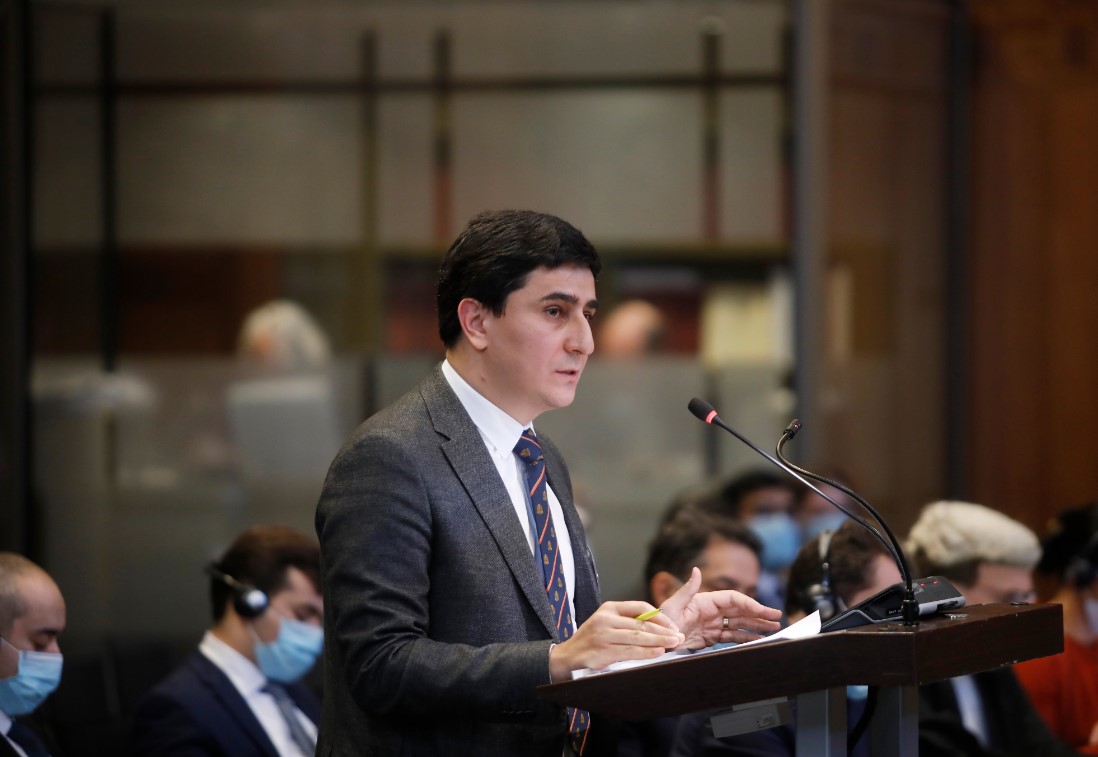
Azerbaijan cynically opened the Lachin corridor for first time in nine months to only to let out more than 100 000 fleeing Armenians, Armenia’s Representative on International Legal Matters Yeghishe Kirakosyan said at the International Court of Justice hearing in the case Armenia v. Azerbaijan.
“Despite comprising for millennia the great majority of the population of Nagorno Karabakh, almost no ethnic Armenians remain in Nagorno Karabakh today. If this is not ethnic cleansing, I do not know what it is,” Kirakosyan said.
He noted that Azerbaijan deliberately interrupted vital public utilities and starved the ethnic Armenians of Nagorno Karabakh for nine months before brutally killing them and causing them to flee their ancestral home,
“I expect my counterpart to tell you that Azerbaijan will permit those it considers its citizens to return. He promised the same thing in October 2021, when he claimed that in areas transferred to Azerbaijan in 2020 “Azerbaijan was committed to the return of displaced persons regardless of the national or ethnic identity or origin.” Two years later not a single ethnic Armenian has been permitted to return to those areas, and instead, virtually all remaining Armenians of Nagorno Karaabkh have been forced to flee their homes,” Armenia’s representative said.
He noted that two provisional measures issued by the International Court of Justice did not deter Azerbaijan from escalating violations.
“Since September 2020 Azerbaijan has been taking steps to cleanse Nagorno Karabakh of ethnic Armenians and has been doing so while Armenia’s claims are pending at the Court. Political considerations may have prevented the international community from stopping it,” Kirakosyan said, adding that there is still time to prevent the forced displacement of ethnic Armenians from becoming irreversible and to protect the very few Armenians that remain in Nagorno Karabakh, as well as those who have abducted and are currently unlawfully detained in Azerbaijan’s prisons.
“Azerbaijan’s cynicism crosses any imaginable boundaries. It complains that Armenia’s claims before this Court “counter norms and principles of international law” and asserts that such actions “constitute the main threat to establishment of peace, security and justice in the region” and alleges that Armenia “is not interested in the process of peace and normalization with Azerbaijan.” Such remarkable stance is in stark conflict with the establishments of the international legal order, which is based on the premise that disputes should be solved by peaceful means only,” Kirakosyan stated.
“This in fact reflects the way Azerbaijan prefers to solve its disputes, i.e. by resorting to illegal threats to use of force. This is how Azerbaijan understands peace and security,” he added.
“Nothing other than targeted, unequivocal provisional measures protecting the rights of ethnic Armenians of Nagorno Karabakh will suffice to prevent the ethnic cleansing Azerbaijan is perpetrating from continuing and becoming irreversible, to safeguard Armenians’ millennia-long enduring cultural presence in Nagorno Karabakh from being eradicated as it was already done in Nakhijevan and is being elsewhere in Azerbaijan, and to protect the abducted military-political leadership of Nagorno Karabakh from fabricated criminal charges,” Yeghishe Kirakosyan stated.
“If your provisional measures retain any ambiguity whatsoever, Azerbaijan will exploit them and in doing so will ensure that ethnic Armenian presence and history of Nagrono Karabakh are permanently wiped out,” Kirakosyan stated.
He demanded from the Court to indicate the following provisional measures against Azerbaijan:
1) Azerbaijan shall refrain from taking any measures which might entail breaches of its obligations under the CERD;
2) Azerbaijan shall refrain from taking any actions directly or indirectly aimed at or having the effect of displacing the remaining ethnic Armenians from Nagorno Karabakh, or preventing the safe and expeditious return to their homes of persons displaced in the course of the recent military attack including those who have fled to Armenia or third States, while permitting those who wish to leave Nagorno Karabakh to do so without any hindrance;
3) Azerbaijan shall withdraw all military and law-enforcement personnel from all civilian establishments in Nagorno-Karabakh occupied as a result of its armed attack on 19 September 2023;
4) Azerbaijan shall facilitate, and refrain from placing any impediment on, the access of the United Nations and its specialized agencies to the ethnic Armenians of Nagorno-Karabakh, and shall not interfere with their activities in any way;
5) Azerbaijan shall facilitate, and refrain from placing any impediment on, the ability of the International Committee of the Red Cross to provide humanitarian aid to the ethnic Armenians of Nagorno-Karabakh, and shall cooperate with the International Committee of the Red Cross to address the other consequences of the recent conflict;
6) Azerbaijan shall immediately facilitate the full restoration of public utilities, including gas and electricity, to Nagorno-Karabakh, and shall refrain from disrupting them in the future;
7) Azerbaijan shall refrain from taking punitive actions against the current or former political representatives or military personnel of Nagorno-Karabakh;
8) Azerbaijan shall not alter or destroy any monument commemorating the 1915 Armenian genocide or any other monument or Armenian cultural artefact or site present in Nagorno-Karabakh;
9) Azerbaijan shall recognize and give effect to civil registers, identity documents and property titles and registers established by the authorities of Nagorno-Karabakh, and shall not destroy or confiscate such registers and documents;
10) Azerbaijan shall submit a report to the Court on all measures taken to give effect to this Order within one month, as from the date of this Order, and thereafter every three months, until a final decision on the case is rendered by the Court.”