



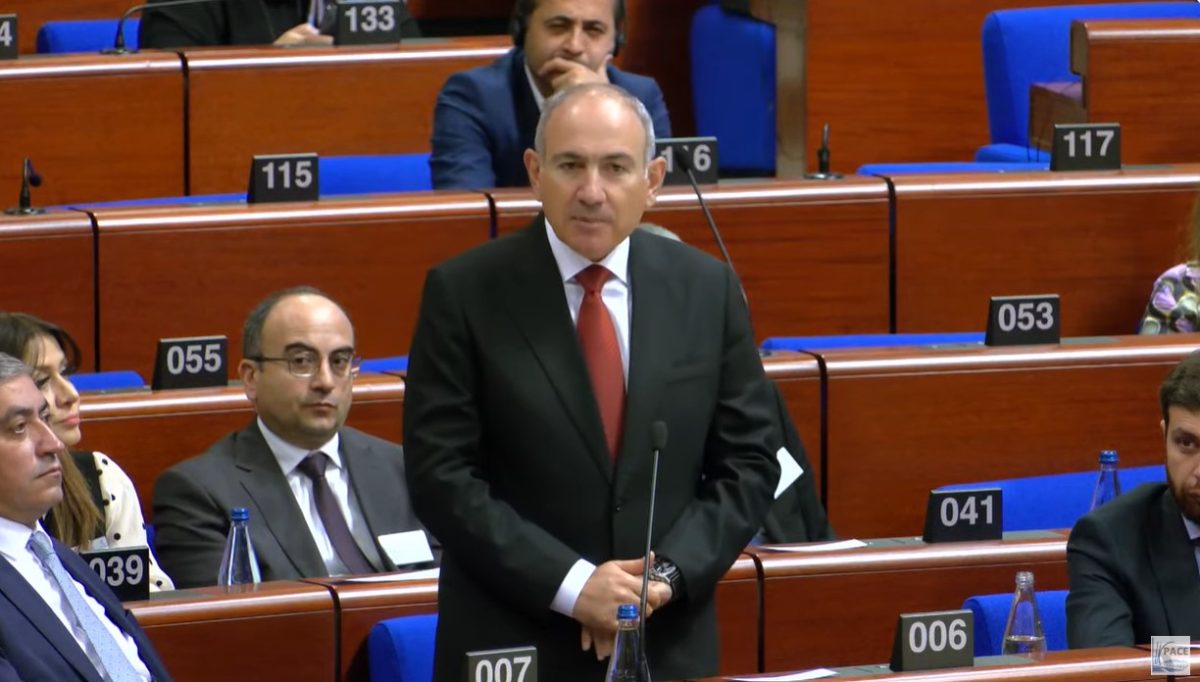
Armenian Prime Minister Nikol Pashinyan told the Parliamentary Assembly of the Council of Europe (PACE) that there is no need for constitutional changes in Armenia as a prerequisite for signing a peace agreement with Azerbaijan, stressing that the draft treaty itself provides sufficient legal guarantees.
Pashinyan addressed concerns raised by Baku that Armenia’s Constitution allegedly contains territorial claims against Azerbaijan. He recalled that in September 2024 Armenia’s Constitutional Court had examined the regulations for the joint Armenia–Azerbaijan border delimitation commissions — the first bilateral inter-state document between the two countries — and ruled that it did not contradict the Armenian Constitution.
He highlighted that both in the Prague declaration of October 2022 and in the draft peace agreement already initialed, Armenia and Azerbaijan reaffirmed their commitment to the 1991 Alma-Ata Declaration, which recognizes the territorial integrity and sovereignty of the former Soviet republics within their existing borders.
“The peace agreement explicitly records that neither side has territorial claims against the other, and both commit not to raise such claims in the future,” Pashinyan said. He underlined that the treaty also stipulates that neither party can use its internal legislation as a justification for failing to implement the agreement.
According to Armenia’s legal framework, once the peace agreement is signed it must be submitted to the Constitutional Court for review. If the Court confirms compliance with the Constitution, Parliament can ratify it, giving the agreement “higher legal force than domestic legislation,” the Prime Minister stressed. “Therefore, in the context of the peace agreement, there is no constitutional problem at all.”
At the same time, Pashinyan reiterated that Armenia has long recognized the need for a new Constitution, but for reasons unrelated to peace negotiations. He linked this to a deeper issue of public trust, pointing to a history of electoral falsifications and contested constitutional referendums.
“In Armenia, many citizens feel that the existing constitutional order was not established by their free decision. This has created, so to say, an allergic reaction to the state and to the legal system. The only way to overcome this is through the adoption of a new Constitution that is genuinely owned by the people,” he said.
Concluding his remarks, Pashinyan argued that even if one were to assume Azerbaijan’s concerns were legitimate, the swiftest and most effective way to address them would still be through signing and ratifying the peace agreement, which establishes a binding legal prohibition on any future territorial claims.