



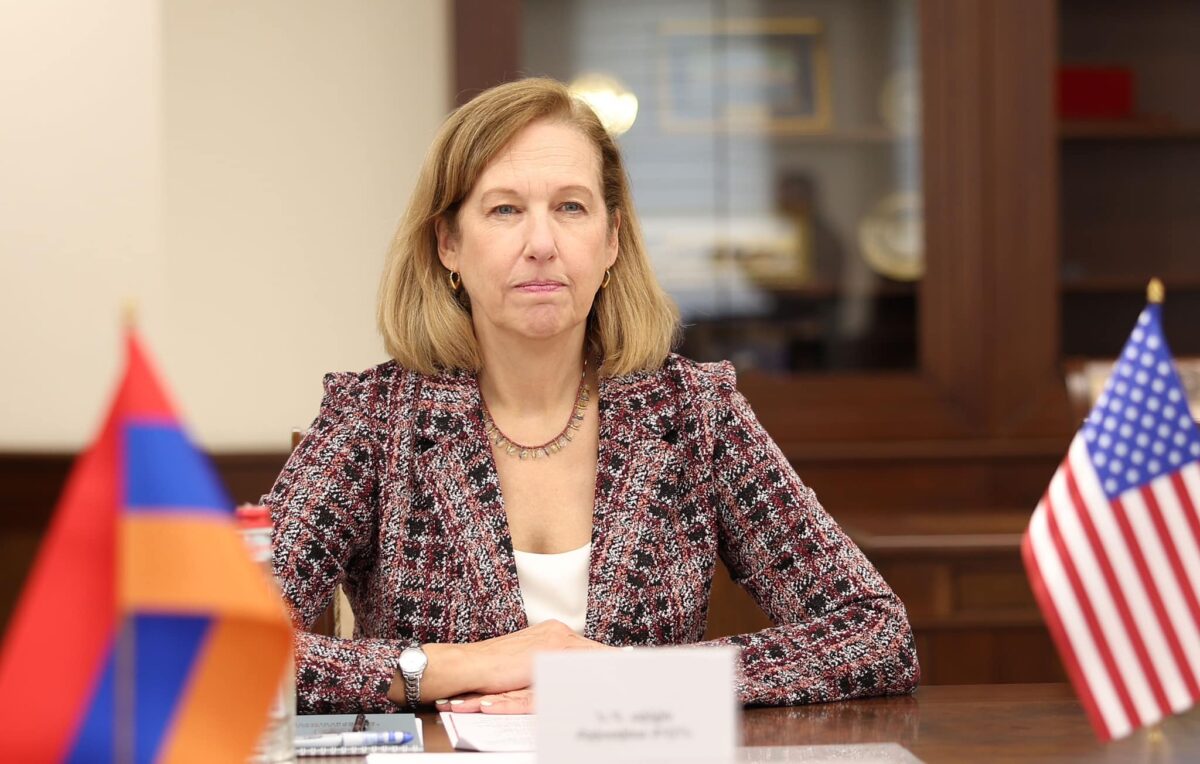
U.S. Ambassador to Armenia Kristina Kvien hailed significant progress toward peace in the South Caucasus and outlined a broad agenda for deepening U.S.–Armenia cooperation during her address to the 108th NATO Rose-Roth Seminar held in Yerevan.
Speaking to parliamentarians and officials gathered in the Armenian capital, Ambassador Kvien said Armenia stands “at a truly historic time,” pointing to major diplomatic breakthroughs achieved during the August 8 Peace Summit hosted by U.S. President Donald Trump at the White House.
At the summit, the foreign ministers of Armenia and Azerbaijan initialed the text of a peace and inter-state relations agreement, while Armenian Prime Minister Nikol Pashinyan and Azerbaijani President Ilham Aliyev signed a joint declaration committing to the opening of regional communications and the creation of the Trump Route for International Peace and Prosperity (TRIPP). President Trump also signed three Memoranda of Understanding with Armenia and one with Azerbaijan, outlining future bilateral cooperation.
The Armenian memoranda focus on strategic sectors including transportation and connectivity — supporting PM Pashinyan’s Crossroads of Peace initiative — border security, artificial intelligence and semiconductor development, as well as energy and cybersecurity.
Ambassador Kvien highlighted that on September 11, during a visit to Yerevan, U.S. officials announced Washington’s intent to provide $145 million in assistance to help implement the agreements. “These steps have brought us further in a short period of time than we thought possible at the start of 2025,” Kvien said, urging Armenia and Azerbaijan to swiftly sign and ratify the peace accord.
The Ambassador also welcomed improving ties between Armenia and Türkiye, expressing hope for concrete progress such as the opening of the Margara border crossing to diplomats and third-country nationals.
Detailing new areas of cooperation, Kvien announced plans for:
- Meetings to develop the TRIPP corridor, a multimodal transit route connecting mainland Azerbaijan with Nakhchivan while preserving Armenia’s sovereignty and jurisdiction.
- Private-sector partnerships, including a planned $500 million AI data center by San Francisco-based Firebird by early 2026.
- Energy security initiatives, including negotiations for a U.S.–Armenia civil nuclear cooperation agreement (123 Agreement).
- Border security programs, with upcoming visits from U.S. Export Control and Border Protection officials.
- Collaboration on a national cybersecurity strategy and creation of a National Computer Incident Response Team.
Kvien also underscored the U.S.–Armenia defense partnership, noting about $18 million in Foreign Military Financing for armored ambulances, a Cyber Defense Operations Center, and training facilities. She praised the success of the Eagle Partner joint peacekeeping exercises and Armenia’s ongoing participation in the NATO KFOR mission in Kosovo.
Closing her remarks, Ambassador Kvien called on national parliaments and regional organizations to “seize the momentum established by President Trump to lock in peace, normalize relations, and develop the potential of Armenia as a nexus of trade and commerce and an anchor of stability between east and west.”