


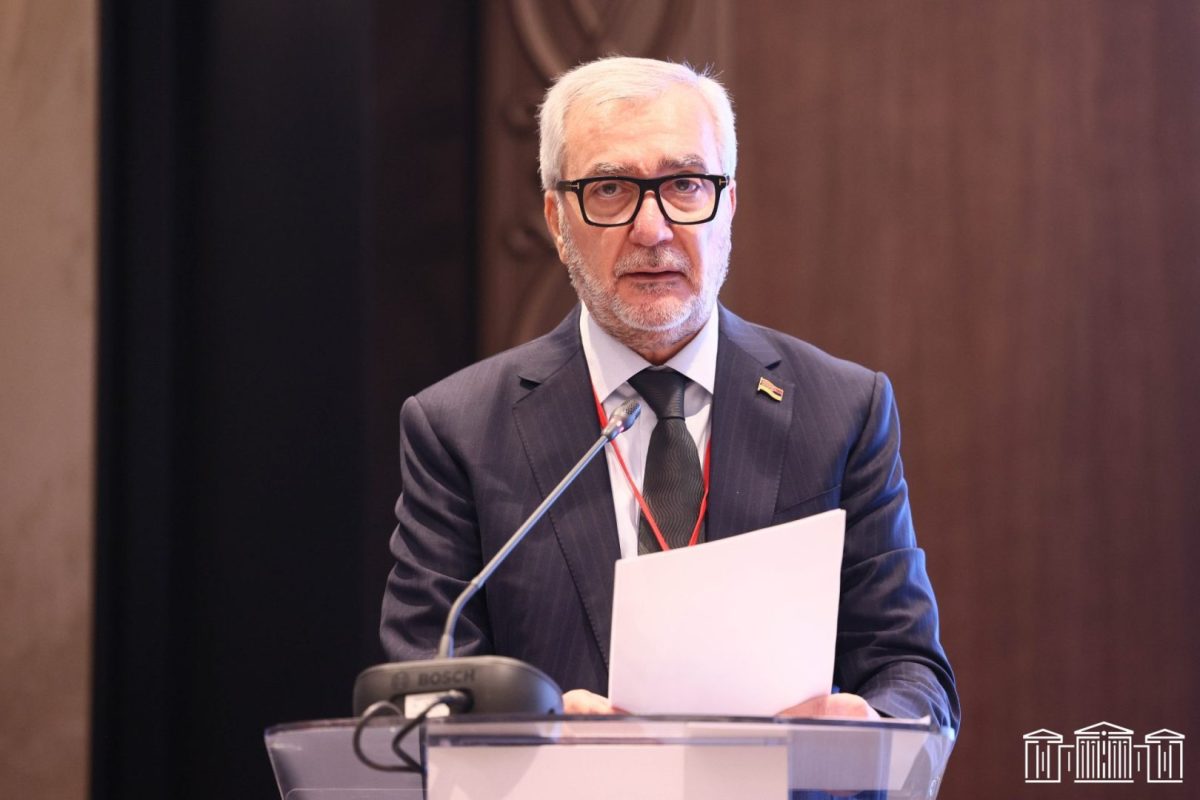
We believe that a lasting peace based on sovereignty, territorial integrity, and the inviolability of borders is achievable, said Andranik Kocharyan, Chair of the Standing Committee on Defense and Security of Armenia’s National Assembly, opening the 108th NATO Parliamentary Assembly Rose-Roth Seminar in Yerevan on September 22.
Kocharyan, who also heads Armenia’s delegation to the NATO PA, welcomed participants from across the Alliance, including ambassadors, parliamentarians, and experts, emphasizing that Armenia was honored to once again host the key dialogue platform after a ten-year hiatus — the previous seminar in Yerevan took place in 2015.
In his address, Kocharyan stressed that the seminar is taking place at a critical moment, when regional and global challenges demand stronger international cooperation, political will, and the exchange of best practices. He highlighted the relevance of the topics on the agenda, including:
- the Armenia-Azerbaijan peace process,
- regional geopolitical competition,
- democracy and resilience,
- hybrid threats and disinformation,
- and regional economic cooperation.
Kocharyan recalled the August 8, 2025 Washington trilateral meeting between Armenia’s Prime Minister Nikol Pashinyan, U.S. President Donald Trump, and Azerbaijan’s President Ilham Aliyev, where a joint declaration was signed laying the foundation for peace and interstate relations between Armenia and Azerbaijan.
He stressed that the peace process between Armenia and Azerbaijan is not only a national and regional priority, but also a matter of global security.
“This process is not only a guarantee for restoring bilateral relations but also a new opportunity to transform the region,” Kocharyan said, adding that it must be built on the principles of sovereignty, territorial integrity, the inviolability of borders, jurisdiction, and reciprocity.
He emphasized that Armenia’s “Crossroads of Peace” strategic vision is in full harmony with the principles enshrined in the August 8, 2025 Washington Declaration, signed by Armenia’s Prime Minister Nikol Pashinyan, U.S. President Donald Trump, and Azerbaijan’s President Ilham Aliyev. This vision proposes the reactivation of transport and infrastructure links, economic connectivity, and mutual trust-building measures.
“This historic opportunity must be seized to transform the regional political environment and to consolidate peace through economic cooperation, trade, and cultural exchanges,” Kocharyan underlined.
At the same time, Kocharyan warned against ignoring global geopolitical shifts, which he said are shaping new realities and presenting fresh security challenges and competitive agendas. These changes, he argued, require not just adequate responses but deeper integration into the international security architecture.
Touching upon Armenia-NATO relations, Kocharyan noted that cooperation dates back over 30 years, beginning with the “Partnership for Peace” program in 1994 and later developing into the Individual Partnership Action Plans. Negotiations are now underway for an Individually Tailored Partnership Program, which would further deepen collaboration in defense reform, civilian oversight, transparency, military education exchanges, and participation in peacekeeping missions.
Kocharyan warned, however, that Armenia faces hybrid threats and disinformation campaigns aimed at undermining democratic institutions and public trust. He called for joint efforts to strengthen digital literacy, civil society, and information security, stressing that hybrid warfare, cyberattacks, and disinformation are no longer secondary phenomena but “fundamental threats to national and international security.”
He also underlined the importance of civilian oversight in defense and security as a key element of democratic resilience and urged continuous work to improve transparency and accountability mechanisms.
Concluding his remarks, Kocharyan expressed confidence that the seminar will generate valuable insights and practical proposals to help Armenia enhance democratic control, strengthen security policy, and advance peace and stability in the South Caucasus.