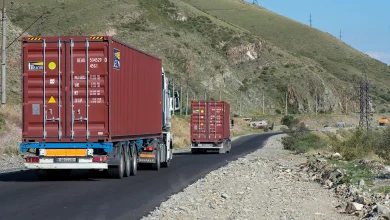




Armenia is set to reopen its transport links under a new agreement with Azerbaijan, paving the way for reciprocal use of each other’s roads and railways within the framework of mutual sovereignty, territorial integrity, and jurisdiction.
The arrangement will also establish a transit route through Armenia to Nakhichevan, while granting Armenia direct rail access to Iran, China, Central Asia, and Russia, Public Radio’s Astghik Sargsyan reports from Washington, DC.
Under the terms of the deal, all infrastructure passing through Armenian territory will remain fully under Armenia’s sovereignty — meaning Armenian laws, state institutions, and law enforcement will operate there as in any other part of the country. The unobstructed transit to Nakhichevan will likewise fall entirely within Armenia’s legal and territorial framework.
One of the most ambitious elements of the plan is the “Trump Route” infrastructure investment program. While its management model is not unprecedented for Armenia — similar arrangements are in place for the South Caucasus Railway and Zvartnots International Airport — the project’s investment scale is unmatched. It covers not only railways and highways, but also pipelines, power transmission lines, and communications cables, making it a significant source of both revenue and security for Armenia.
In a landmark diplomatic step, the Peace Agreement between Armenia and Azerbaijan is expected to be initialed in the presence of the U.S. President. Both sides will pledge to maintain peace, renounce revenge, and abandon any attempts to seize each other’s territory — commitments based on the recognition that the territories of the former Armenian SSR and Azerbaijani SSR correspond to the borders of today’s independent states.
The parties also plan to jointly petition the OSCE to dissolve the Minsk Group, arguing that its existence has become unnecessary in light of the mutual renunciation of territorial claims.
The “Trump Route” is seen as a strategic infrastructure initiative aimed at building new regional connectivity networks and fostering stronger international ties. It has the potential to serve as the practical foundation for a broader Armenia–U.S. investment accord.