


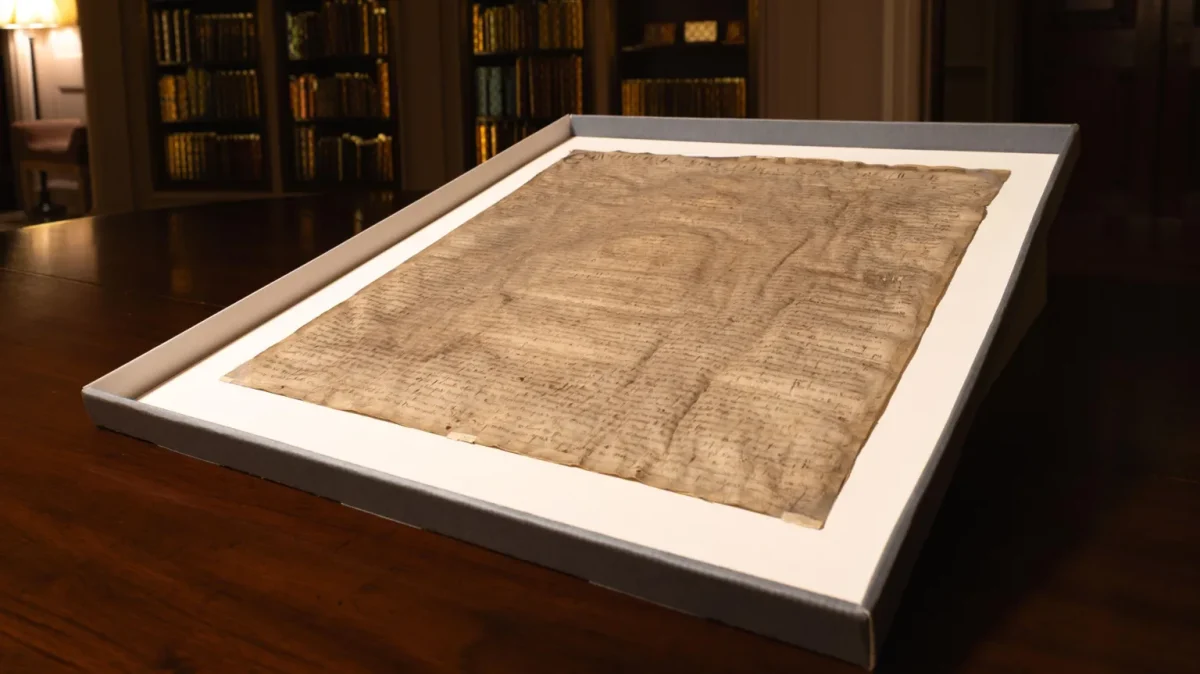
A manuscript once considered an unofficial “copy” of the Magna Carta is now believed to be a genuine version and ”one of the world’s most valuable documents”, according to UK academics, the BBC reports.
Harvard Law School paid $27.50 (then about £7) for it in 1946 and for years it has remained tucked away in its library, its true identity unknown.
But two medieval history professors have concluded it is an extraordinarily rare and lost original Magna Carta from 1300, in the reign of King Edward I, that could be worth millions.
”This is a fantastic discovery,” said Prof David Carpenter from King’s College London, who began analysing it after seeing digitised images of it on the US university’s website.
According to Harvard’s library accession register, the document catalogued as HLS MS 172 was acquired in 1946 and was described in an auction catalogue as a “copy made in 1327… somewhat rubbed and damp-stained”.
The Magna Carta is a charter first issued by King John in 1215 that guaranteed the liberties and rights of his subjects and also placed the Crown under the authority of the law.
Considered a key step in the evolution of human rights against oppressive rulers, Magna Carta has influenced the framing of constitutions around the world.
The document – which was circulated across the counties of England – was reissued after 1215 by successive kings through the years to 1300, meaning “there may have been 200 originals”, said Prof Nicholas Vincent of the University of East Anglia, Norwich, who helped Prof Carpenter establish the Harvard document’s authenticity and provenance.
Today, 25 of these originals survive from the various editions between 1215 and 1300, most of which are in the UK.
There are two more in Washington DC’s National Archives, and one in Parliament House in Canberra, Australia.