


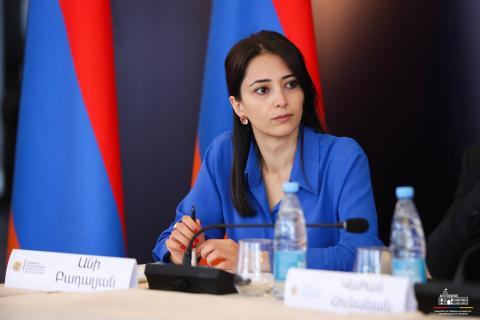
The Government of the Republic of Armenia has announced on the highest level that it has neither an objective nor a goal to escalate the situation and continues to act by the principles of the agenda of peace, Spokesperson for the Armenian Foreign Ministry, Ani Badalyan, said in an i terview with Armenpress.
The comments come in the wake of statements by Azerbaijani Foreign Ministry spokesperson Aykhan Hajizada, who falsely accused Armenia of violating the ceasefire and failing to fulfil its obligations.
“The Armed Forces of Armenia are subordinate to the Government and function under this very logic. The Ministry of Defense of Armenia has announced that it is ready to investigate facts substantiating the reports of the Azerbaijani Defense Ministry, should such be provided to Armenia. So far Azerbaijan hasn’t conveyed any factual information to us about ceasefire violations allegedly committed by Armenia. Azerbaijan has also not responded to the 22 June 2024 proposal made by the Republic of Armenia on creating a joint mechanism for investigating cases of ceasefire violations and/or such reports,” Badalyan said.
Commenting on the statement by the Prime Minister’s Office of Armenia, the Azerbaijani Foreign Ministry spokesperson accused Armenia of proposing difficult initiatives that are practically unfulfillable.
“Armenia and Azerbaijan have officially announced the finalization of the draft agreement “On Peace and Establishment of Interstate Relations” and the conclusion of the negotiations around finalizing the draft. Logically, the agreed-upon document must be signed, and the Republic of Armenia proposes to launch consultations about the venue and timeframes for signing it. Clearly the proposed process is neither difficult nor unfulfillable,” the Armenian MFA Spokesperson said.
The Azerbaijani Foreign Ministry spokesperson also spoke about the need for dissolving the OSCE Minsk Group and constitutional amendments in Armenia.
In this regard, Ani Badalyan stated: “The Republic of Armenia has announced on the highest level its readiness to consider the dissolution of the OSCE MG. Armenia simply wants to make sure that this would mean the de facto and de jure end to the conflict and not its shift to the territory of the Republic of Armenia under the narrative of the so-called ‘Western Azerbaijan’.”
Regarding the Armenian Constitution, she saud the 26 September 2024 ruling of the Armenian Constitutional Court made it obvious that the Armenian Constitution doesn’t contain any territorial claims against any country.
“On the contrary, the Republic of Armenia believes that it is Azerbaijan’s Constitution that contains territorial claims against Armenia. But we also believe that the finalized text of the peace treaty solves this issue. Why? Because the finalized text stipulates that Armenia and Azerbaijan recognize each other’s territorial integrity within the borders of the USSR republics, don’t have territorial claims against each other and are bound to not make such claims in the future. Besides, the text of the agreement underscores that the parties cannot cite their domestic legislation for failure to fulfill the terms of the agreement,” Badalyan noted.
She referred to Article 5 of the Armenian Constitution, which stipulates that ‘in case of conflict between the norms of international treaties ratified by the Republic of Armenia and those of laws, the norms of international treaties shall apply’, i.e., the Armenian Constitution cannot be cited as an obstacle for not signing the peace agreement.
Therefore, the Spomesperson said, “the signing of the peace agreement is even the most effective way to address the concerns pertaining to the Constitution.”
Azerbaijan further accuses Armenia of failure to fulfill obligations on reopening regional connections and offering complex and long routes for transport link between Azerbaijan’s western regions and Nakhchivan.
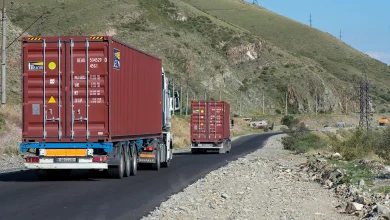
“Armenia doesn’t have unilateral obligations in the issue of opening regional economic and transport connections. The separate agenda of the transport connection between Azerbaijan’s western regions and Nakhchivan is part of a bigger agenda of unblocking regional transport and economic ties, which also includes the unblocking of the Republic of Armenia. Secondly, Armenia has proposed, in the first phase, to launch the Zangelan-Meghri-Ordubad-Yeraskh railway cargo transportations. This is the shortest possible railway between Zangelan and Ordubad. Regarding the roads, we have the kind of roads and terrain that we have and to accuse us of being a mountainous country would be unserious, to say the least,” Ani Badalyan said.
Responding to Azerbaijan’s accusations of of militarization and deployment of offensive armaments in the border areas, and preparations for a scenario of using force, the Spokesperson noted: “A scenario of using force? For solving what issue? Which issue on the agenda of the Republic of Armenia could imply the use of force? Only the issue of more than 200 square kilometers of occupied territory of the Republic of Armenia could had caused such interpretation, but the Republic of Armenia has clearly expressed its stance about this, that it doesn’t seek to solve this issue through force because the delimitation process, and now also the finalized text of the peace agreement, have created all possibilities for peacefully resolving that issue. Armenia can only prepare for one scenario of force, i.e., to withstand a possible aggression, which is the legitimate right of any country, and every step by Armenia in the border regions fit exclusively in the logic of defense.”
She recalled that back in 2021 Armenia proposed a reciprocal, mirror withdrawal of troops from border areas, which Azerbaijan rejected.
“In this context, the region’s militarization can be concerning, and Armenia has proposed Azerbaijan to create a bilateral mechanism for mutual arms control to resolve this issue, but so far Azerbaijan hasn’t given a positive response. The Republic of Armenia doesn’t conduct militarization, it conducts a strategy of army transformation, which is a public document. I once again reiterate the commitment of the Republic of Armenia to the agenda of peace and call on Azerbaijan to launch consultations about the date and venue for signing the finalized text of the agreement on peace and interstate relations,” Badalyan concluded.