



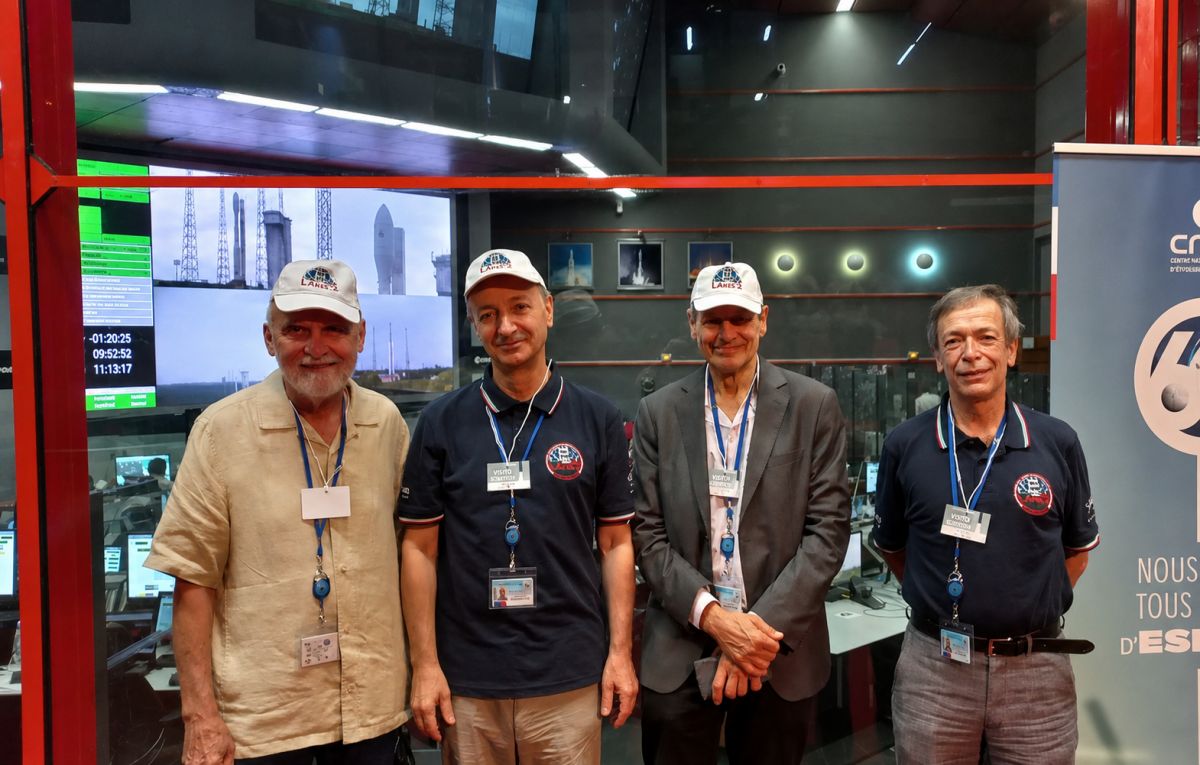
A groundbreaking study published in the latest issue of Nature has confirmed one of Albert Einstein’s key predictions with unprecedented precision, with Armenian astrophysicist Professor Vahagn Gurzadyan among the international team of researchers behind the achievement.
The paper, titled “LARES-2 Satellite Measures Frame-Dragging Effect Around the Earth,” reports the most accurate measurement to date of the frame-dragging phenomenon – a subtle effect predicted by Einstein’s general theory of relativity, in which a rotating massive body such as Earth drags the fabric of spacetime around with it.
Professor Gurzadyan, head of the Center for Cosmology and Astrophysics at the A.I. Alikhanyan National Science Laboratory (Yerevan Physics Institute), is one of the study’s co-authors. The laboratory participates in the international LARES mission, a collaboration involving the Italian Space Agency (ASI), the European Space Agency (ESA), and several leading scientific institutions.
The research is based on data collected by the LARES-2 satellite, launched in 2022, together with observations from the earlier LAGEOS and GRACE satellites. According to the researchers, LARES-2’s optimized orbit, extremely low surface-to-mass ratio, and highly uniform retroreflector distribution enabled scientists to measure Earth’s frame-dragging effect with a relative uncertainty of just one part in a thousand – an order-of-magnitude improvement over previous measurements in the Solar System.
The findings provide one of the most stringent confirmations yet of Einstein’s general theory of relativity in the near-Earth environment. They also place strong constraints on alternative theories of gravity that predict deviations from general relativity, including scalar-tensor models such as Chern-Simons gravity.
Beyond its significance for fundamental physics, the research has practical implications for geophysics. The combined analysis of the LARES-2 and LAGEOS satellites improves the determination of Earth’s lunisolar tides and contributes to more precise studies of the planet’s gravitational field.
The study has attracted widespread international attention. Scientific American highlighted the findings in an article titled “The Earth Is Dragging Spacetime Around Its Orbit, Just as Einstein Predicted,” describing the LARES-2 measurements as among the most precise ever made of the frame-dragging effect. The research has also been covered by Ars Technica, Italy’s Rai Radio 3 and MeteoWeb, Russia’s TASS news agency, and other international media outlets.
The publication marks another high-profile international scientific achievement involving Professor Gurzadyan. In September 2025, Nature Partner Journals – Heritage Science published a study co-authored by Gurzadyan and archaeologist Arsen Bobokhyan on Armenia’s unique vishapakars (dragon stones), research that also received extensive international media coverage.