


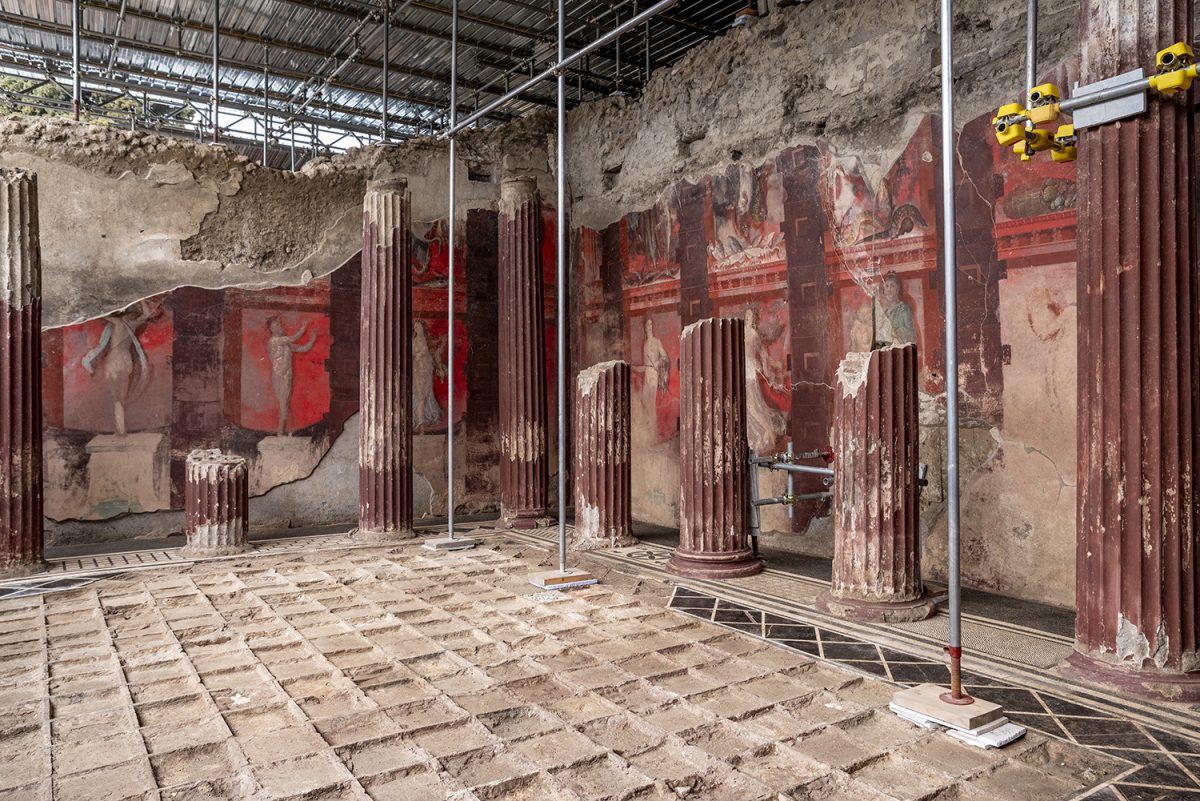
Archaeologists in Pompeii have uncovered rare, nearly life-sized frescos that offer fresh insight into religious practices in the ancient city before it was destroyed by Mount Vesuvius in AD 79, Reuters reports.
The discovery features a large-scale frieze that spans three walls of a banquet hall, presenting vivid imagery of the initiation rites for followers of Dionysus — the ancient Greek god of wine, fertility, theatre and religious ecstasy.
Dionysian initiation rituals, known as the Mysteries of Dionysus, were secretive religious rites dedicated to the god, promising spiritual enlightenment and possibly a blessed afterlife.
The fresco, dating to 40–30 BC, presents vivid imagery of Dionysian followers in states of ritualistic ecstasy, dancing and hunting, resembling the famed frescoes of the nearby Villa of the Mysteries which were uncovered 100 years ago.
The giant frieze illustrates the female followers of Dionysus as both dancers and fierce huntresses, carrying a slaughtered goat on their shoulders or holding a sword and the entrails of an animal in their hands.
Satyrs, identifiable by their pointed ears, play double flutes and perform wine libations. At the center, is a fresco of an elegantly dressed woman who is possibly awaiting to be initiated into the mysteries.
An upper frieze depicting live and sacrificed animals, including a fawn, a freshly gutted boar, roosters, and fish. Researchers said this juxtaposition underscored the dual nature of Dionysian worship, combining revelry with primal sacrifice.
“The question is, what do you want to be in life, a huntress, a hunter or the prey?” said the director of the Pompeii site, Gabriel Zuchtriegel.
The archaeological site of Pompeii covers approximately 66 hectares (165 acres), with about 44 hectares (110 acres) fully excavated. The latest dig is in an area known as Regio IX which began in early 2023 and has so far revealed over 50 rooms, including workshops and atrium houses.
South of these structures, archaeologists unearthed several elite living spaces, including a black salon depicting scenes from the Trojan War, an extensive thermal complex and a fresco that depicts what might be an ancestor of the Italian pizza.