


Armin Wegner, a German soldier and medic, wrote a lengthy letter on December 14, 1932, asking Franz Werfel not to write his novel, “The Forty Days of Musa Dagh,” because he was in the midst of writing his own four-volume book on Armenians, California Courier publisher Harut Sassounian writes in a new article.
Werfel responded to Wegner with a short letter on December 23, 1932, explaining that their planned books did not conflict with one other, as they were about different aspects of the Armenian Genocide.
Armin Wegner, a German soldier and medic, was sent to the Ottoman Empire during World War I, while the two countries were allies. Wegner was stationed along the Baghdad Railway in Syria and Mesopotamia, where he witnessed the deportations and mass killings of Armenians, subsequently known as the Armenian Genocide. He wrote several books describing his eyewitness accounts.
Contrary to the Ottoman prohibition of taking pictures during the Armenian Genocide, Wegner took hundreds of rare photographs and smuggled them into Germany. At the Ottoman government’s request, he was arrested and some of his photographs were destroyed. He succeeded, however, in hiding many other negatives in his belt. In 1919, Wegmer sent a letter to U.S. President Woodrow Wilson at the Peace Conference, advocating for an independent Armenia. In 1921, Wegner testified at the trial of Soghomon Tehlirian, who was accused of assassinating Talaat Pasha in Berlin, the Turkish mastermind of the Armenian Genocide.
Tehlirian was found not guilty by the German court and released from jail. Along with his wife, Wegner visited the Soviet Union and Soviet Armenia in 1927 – 28. In 1968, he was invited to Soviet Armenia by the Catholicos of All Armenians and awarded the Order of St. Gregory the Illuminator. Wegner died in Rome in 1978, at the age of 91. Some of his ashes are buried in Armenia.
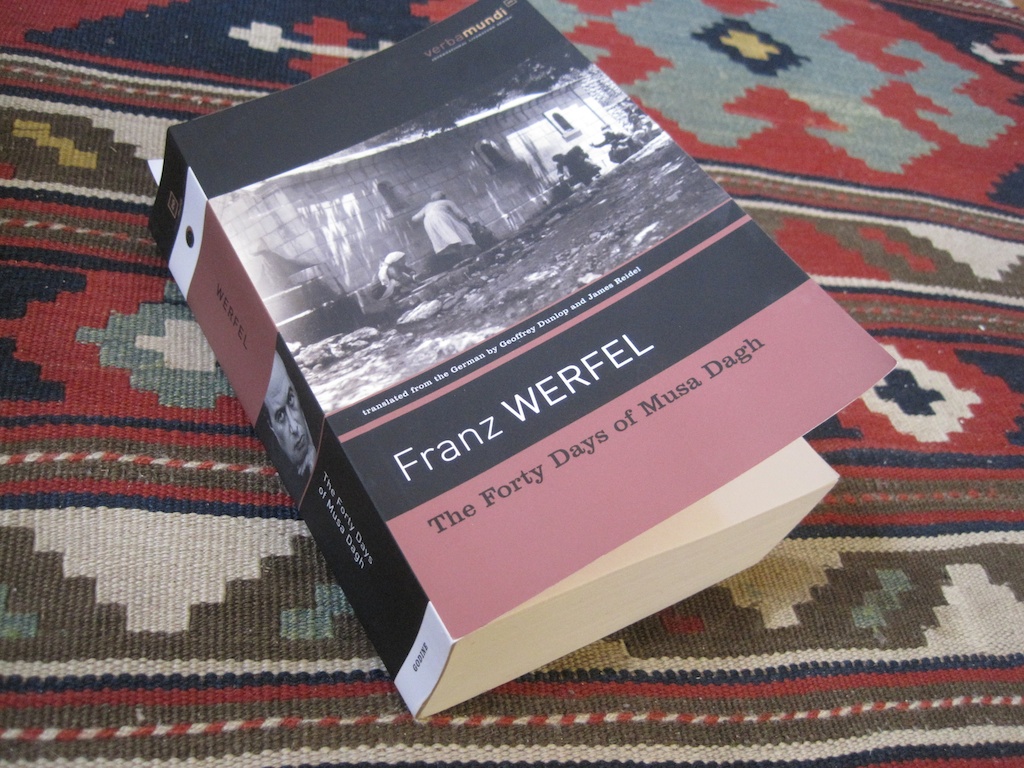
Wegner’s illustrious counterpart was Franz Werfel, a Jewish-Austrian novelist, playwright, and poet. He was well-known for his novel, “The Forty Days of Musa Dagh,” which described the Armenian resistance to the Ottoman troops during the Genocide.
Werfel visited the Middle East twice in 1925 and 1929. While in Damascus, Syria, he encountered Armenian children, survivors of the Genocide, who were in destitute condition, which inspired him to write “The Forty Days of Musa Dagh.”
The world famous novel was published in Germany in 1933. Werfel gave lectures about the Armenian Genocide throughout Germany, as a result of which he was accused of spreading anti-Turkish propaganda. The Nazi newspaper “Das Schwarze” denounced him for carrying out propaganda against “alleged Turkish horrors perpetrated against the Armenians.”
The same German newspaper, suggesting a link between Armenians and Jews, condemned “America’s Armenian Jews for promoting in the U.S.A. the sale of Werfel’s book.” His books were burned by the Nazis. He was forced to flee and eventually settled in Los Angeles, where he died in 1945. His body was reburied in Vienna in 1975.
Interestingly, these two distinguished pro-Armenian writers clashed with each other when Armin Wegner wrote a lengthy letter on December 14, 1932, asking Franz Werfel not to write his novel, “The Forty Days of Musa Dagh,” because he was in the midst of writing his own four-volume book on Armenians. Werfel responded to Wegner with a short letter on December 23, 1932, explaining that their planned books did not conflict with one other, as they were about different aspects of the Armenian Genocide.