


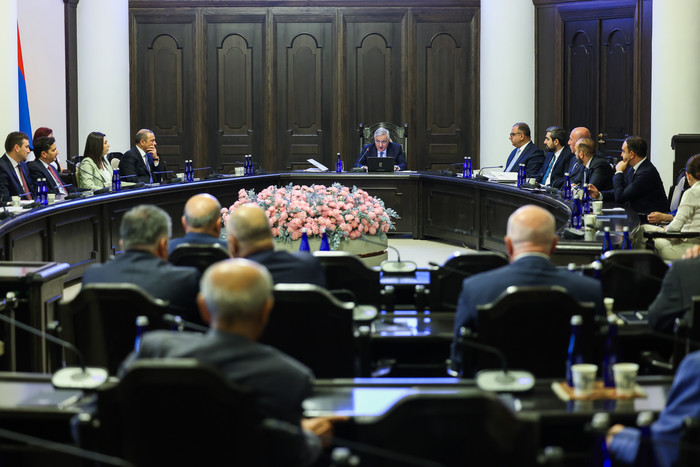
The Armenian government has approved a draft law to ratify the Framework Agreement on Strategic Cooperation between the Republic of Armenia and the United States on the Trump Route for International Peace and Prosperity (TRIPP) project, launching the domestic ratification process for the landmark accord.
The agreement, signed in Washington on June 1 and in Yerevan on June 4, 2026, will enter into force once Armenia completes the required constitutional and parliamentary procedures.
Presenting the decision, Foreign Minister Ararat Mirzoyan said the agreement would first be submitted to the Constitutional Court for review. If the court determines that its provisions comply with Armenia’s Constitution, the ratification bill will then be sent to the National Assembly.
Mirzoyan noted that the framework agreement builds on two earlier documents: the August 8, 2025 Peace Declaration signed by Prime Minister Nikol Pashinyan and Azerbaijani President Ilham Aliyev in the presence of U.S. President Donald Trump, and the “Framework for the Implementation of TRIPP” signed by the Armenian foreign minister and the U.S. Secretary of State on January 13, 2026.
He dismissed speculation that the agreement contains provisions inconsistent with those documents, stressing that it repeatedly refers to and fully aligns with both.
According to Mirzoyan, the agreement aims to promote peace, stability and economic development in the South Caucasus by expanding regional transport links, transport infrastructure and international trade.
The minister emphasized that the project fully respects Armenia’s sovereignty, jurisdiction and territorial integrity, with these principles explicitly enshrined throughout the agreement.
Under the framework agreement, Armenia and the United States will establish the TRIPP Development Company, which will be authorized to create special-purpose companies for individual projects in different areas of Armenia and attract additional partners.
The company will receive land-use and development rights in designated zones for an initial 49-year period. During that period, the United States will hold 74% of the company’s shares, while Armenia will own 26%. If both parties agree to extend the cooperation for an additional 50 years, Armenia’s stake will automatically increase to 49% without requiring additional investment or commitments from the Armenian side.
Mirzoyan stressed that Armenia will retain full sovereign authority over border management, border security, customs administration, migration control, tax collection, state information systems and all other public administrative functions. He added that some operational services could be provided by private operators under a front office/back office model, a system already used in Armenia.
The foreign minister also clarified the role of the newly established TRIPP Plus investment company in the United States, saying it is a U.S.-based investment vehicle created to attract financing for the project. He stressed that it has only an indirect relationship with the TRIPP Development Company to be established in Armenia and was created to comply with U.S. legal and institutional requirements.