


A nationwide poll conducted by the International Republican Institute’s (IRI) Center for Insights in Survey Research (CISR) shows that security and peace are the top issues in Armenia, with national security and border issues cited as the top response by a plurality of respondents (35 percent) when asked what the main problems facing their country.
“Security and peace are clearly the main issues on the minds of Armenians,” said Stephen Nix, Senior Director for Europe and Eurasia at IRI.
A plurality of 47 percent of respondents support the peace treaty being negotiated with Azerbaijan. Additionally, a majority of respondents (55 percent) are satisfied with assistance the government has provided to displaced Armenians from Nagorno Karabakh.
“The data clearly shows that the public views the Pashinyan government’s efforts to assist refugees from Nagorno Karabakh positively,” stated Nix.
The survey also found signs of increasing political disengagement among young Armenians, with 37 percent of youth (age 18 to 35) responding that they would not vote if national parliamentary elections were held next Sunday.
According to Nix, “The government should undertake serious efforts to involve Armenian youth in the political and electoral processes.”
Nikol Pashinyan Remains Most Trusted Political Figure
Despite growing political disengagement, Prime Minister Nikol Pashinyan remains the most trusted politician in Armenia, named by 12% of respondents as the figure they trust most – well ahead of other political leaders. However, a striking 61% of respondents said they do not trust any politician, underscoring a broader public mistrust in the political class.

Support for politicians and political forces
When asked which political party or alliance they would support if elections were held next Sunday, 17% of respondents named the ruling Civil Contract party. Other parties lagged behind, and a significant portion of respondents (28%) said they would not vote, while another 22% were undecided or refused to answer – highlighting widespread political disengagement and volatility in voter preferences.

Public expectations for the Government’s next steps
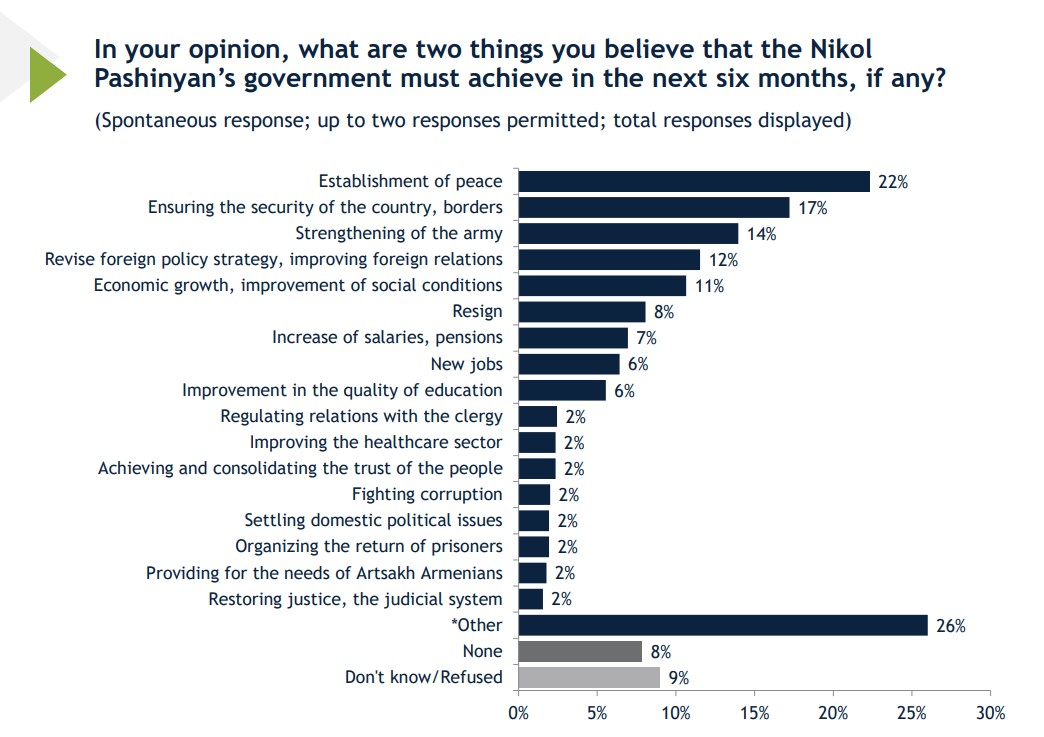
When asked what Prime Minister Nikol Pashinyan’s government should prioritize in the next six months, respondents most frequently cited the establishment of peace (22%) and ensuring national security and border protection (17%). Other key expectations included strengthening the armed forces (14%), revising foreign policy and improving international relations (12%), and fostering economic growth and improving social conditions (11%). A notable 8% of respondents said the government should resign, reflecting lingering public dissatisfaction.
Confidence in Institutions and Direction of the Country
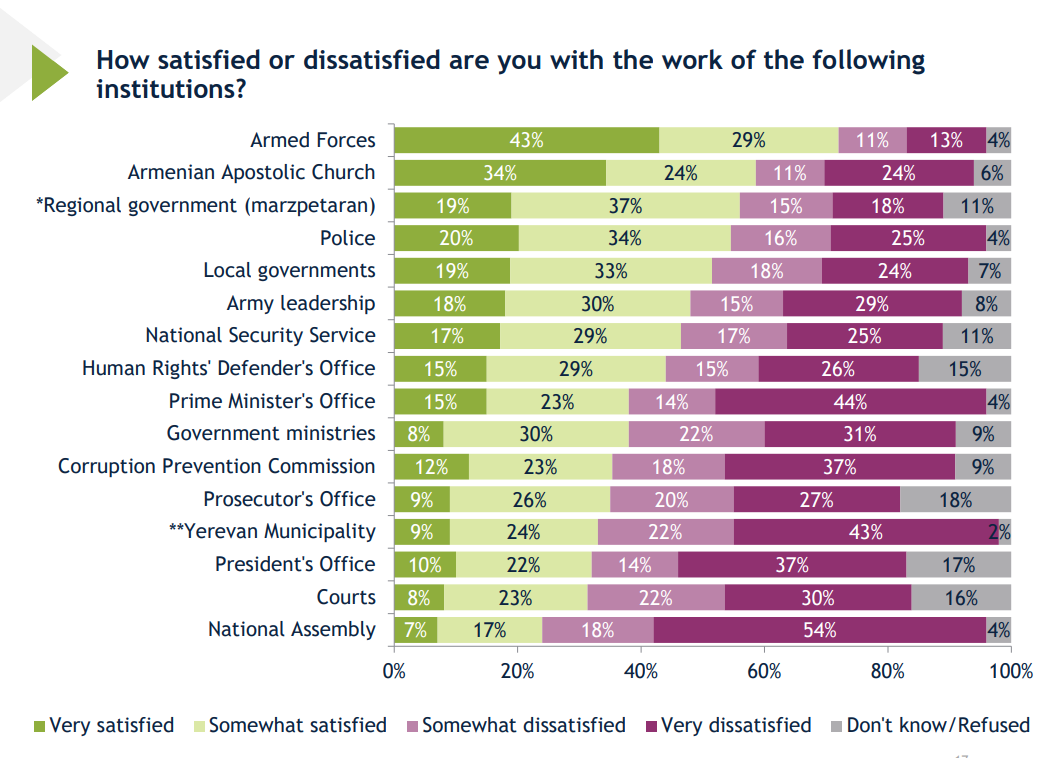
When asked whether Armenia is heading in the right or wrong direction, the public remained divided, with 35% saying the country is on the right path and 43% believing it is on the wrong track. Confidence remains highest in institutions such as the armed forces (74% satisfaction), followed by the Armenian Apostolic Church (54%), while trust is lower in judicial and political institutions.
Main problems facing the country
When asked to name the most pressing issues in Armenia today, respondents pointed to:
- National security and border issues – 35%
- Unemployment – 14%
- Political instability – 12%
- High cost of living – 11%
- Poor governance and weak public administration – 9%
- Low wages – 7%
- Quality of education – 6%
- Weak foreign policy and military capacity – 4% each

Support for Peace Treaty with Azerbaijan
The survey found that 47% of Armenians support the peace treaty currently being negotiated with Azerbaijan, while 40% oppose it. Among supporters, 74% view the establishment of peace in the region as the treaty’s greatest benefit. Among opponents, top concerns included security risks (20%), loss of territory (16%), and distrust of Azerbaijan’s intentions (10%).
Public views on Armenia’s international relationships: France, India, and Iran lead in favorability rankings
When evaluating Armenia’s current foreign relations, the public expressed the most favorable views toward France, India, and Iran, with over 80% rating these relationships as good. Positive sentiment was also strong toward the European Union, USA, and Georgia, while opinions on relations with Russia were notably more mixed – 43% described them as bad, compared to 55% who still considered them good. In contrast, public perception of ties with Turkey and Azerbaijan remains overwhelmingly negative, with 98% and 97% respectively describing those relationships as bad. These results highlight a strong westward and regional tilt in public opinion, coupled with deep skepticism toward Armenia’s traditional adversaries.