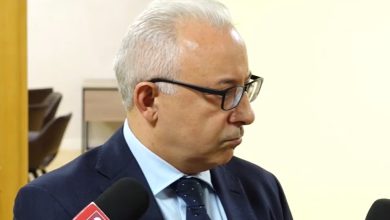



The desire of the Government of the Republic of Armenia and the people of Armenia is to build lasting peace in our region, including – and first of all, normalization of the relations with Azerbaijan, Armenian Foreign Minister Ararat Mirzoyan said at a panel discussion with Foreign Ministers of Azerbaijan and Georgia on the sidelines of the Antalya Diplomacy Forum.
“After long negotiations, we succeeded to agree over the text of the draft peace agreement, and we also suggested immediately to start consultations on defining the venue and the time, the data for signing the peace agreement,” the Foreign Minister said.
“Is this peace agreement, is the agreed text answering all possible questions? Of course, not. And I believe there is no single agreement in the world that answers all possible questions and covers all possible issues. This is a basis, this is a start of relations. And of course, there are many remaining issues, and we can continue our discussion regarding all issues, we can continue exploring new possibilities of cooperation, because it’s just a start. And it’s important to note that in this agreed text of the agreement we have a provision which says that we are establishing a bilateral commission to discuss all the other issues, including the issues that may arise regarding the interpretation of this or that provision of the agreement, discussion of many other possible issues. And again, it’s a matter of a decision, it’s a matter of an approach. What do we, as Ministers of foreign affairs, during this panel discussion, suggest to our societies? What do we as countries suggest to the region, to the world? Is that digging again into the past or building a joint future and prosperity for our citizens? So we are confident that we have all the preconditions, positive preconditions to sign this agreement, to start a new stage of dialogue, a new level, or if I may, to open a new era of relations, of peaceful relations and prosperity in the South Caucasus and beyond, in larger region. So this is our approach,” he noted.
Minister Bayramov spoke about very concrete conditions or preconditions. You know, the Minsk structures.
Speaking about the Minsk Group, Minister Mirzoyan said: “We have expressed several times our readiness to start, initiate the process of dissolution of Minsk structures. These structures can be dissolved when there is no conflict. So this is an interesting question. Do we have a conflict now or not? On the ground, no, we don’t have a de facto conflict. On the papers, we don’t have an agreement on establishment of peace and interstate relations signed and ratified.”
“So we can continue to philosophize on this issue, but the solution for us, at least for us, is obvious. We should sign the agreement, put an end to this conflict in an institutional way, dissolve on the very same day, if you want, in the same, I don’t know, ten minutes, one document after the other. And I’m not even saying which document should be the first. Let’s sign the peace treaty. Let’s sign a joint application to OSCE member states or the secretariat about the dissolution. Let’s establish the bilateral commission, which I just was talking about, and start discussion of all possible questions,” he added.
Minister Bayramov also spoke about the Constitution of Armenia.
Responding to Azerbaijani Foreign Minister Jeyhun Bayramov’s remarks about the Armenian Constitution, Ararat Mirzoyan said: “Okay, if you want, I can say: we do have a concern regarding the Constitution of the Republic of Azerbaijan. And we are not saying this just to have it in the principle of mirroring the issues. We are not saying this to have an equal condition or concern. I can explain. The Constitution of the Republic of Armenia makes a reference to the Act of Independence, the document in which this Republic of Azerbaijan declares itself to be the successor of the first Azerbaijan (Democratic) Republic. And we all know that the first Azerbaijan Republic declared its sovereignty over much larger territories than today’s Republic of Azerbaijan, including, I don’t know, around or more than 60% of current sovereign Armenian territories.”
“So again, it’s a matter of approach. From which end are we beginning? Are we going to have all answers to all possible questions and only then establish relations? Or are we building on what we already have accomplished? Because, you know, we have an unprecedented situation: Armenia and Azerbaijan have agreed on a text of an agreement between them, acknowledging each other’s territorial integrity within borders, which existed at the moment of the dissolution of the Soviet Union. This sentence answers so many questions and so many concerns. Are we going to build on this or are we going to undermine this very tangible, historic accomplishment and then bring another issue to the table of negotiations, and then another issue? It could become a never-ending process. Are we focusing on the future or on the past? This is the question,” he stated.